
What are enterprise AI agents?
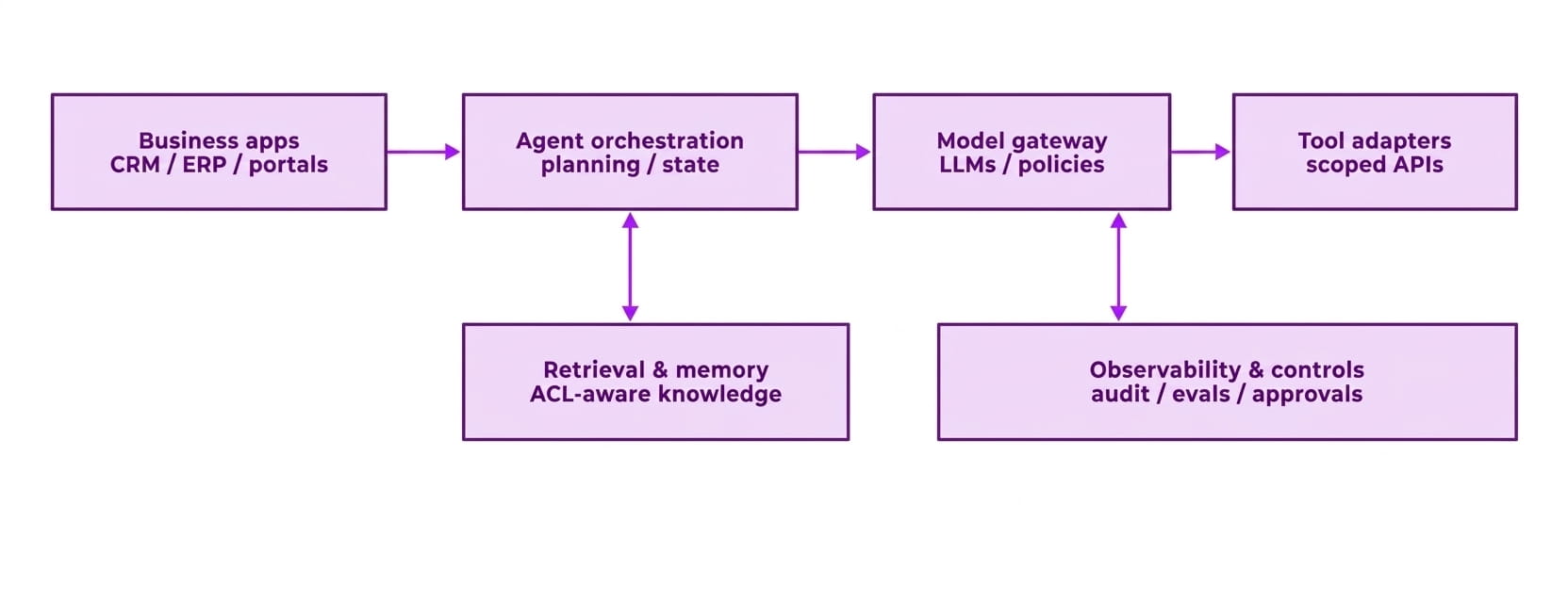
Figure 1. Reference enterprise AI agent architecture (conceptual).An enterprise AI agent is a software system that uses AI to interpret goals, select permitted tools, gather information, and carry out bounded steps toward a business outcome. The system may use a large language model to interpret requests and propose actions, but its reliability depends equally on ordinary software components: identity, APIs, data services, state management, workflow rules, monitoring, and exception handling.
An agent is not simply a chatbot with a different interface. A knowledge assistant may answer an employee question; an agent could retrieve an account record, validate a policy, create a draft ticket, request human approval, and update a CRM once authorized. The ability to act increases potential value—and the consequences of errors.
1. Start with a narrow, measurable workflow
Choose a process that has clear inputs, well-defined completion criteria, accessible systems, and an accountable business owner. Strong early candidates include IT ticket triage, customer support routing, contract clause review, invoice exception handling, and internal knowledge retrieval. Avoid starting with unrestricted purchasing, financial transfers, or production infrastructure changes.
Document the current workflow, average handling time, exception rate, rework, and business impact. Set acceptance thresholds for task success, accuracy, latency, user experience, cost per task, and escalation. Without a baseline, teams cannot distinguish genuine improvement from an impressive demonstration.
Example: service desk agent
A service desk agent could classify an incoming request, retrieve approved troubleshooting articles, check asset metadata, suggest a resolution, and prepare a ticket update. The first release should stop before privileged changes. Later releases can add narrow actions with approvals and rollback mechanisms.
2. Design the enterprise agent architecture
A robust design separates the user interface from orchestration, model access, retrieval, tool execution, policy enforcement, and observability. The orchestration layer manages task state and step limits. A model gateway provides routing, authentication, quotas, and standardized logging. Tool adapters expose narrowly scoped business operations rather than raw database or shell access.
Retrieval services should enforce document permissions at query time. Persistent memory, where needed, requires retention policies and user-specific access controls. For long-running workflows, durable queues and state stores help recover from partial failures. Every action should have a correlation ID and auditable outcome.
| Layer | Responsibility | Key design decision |
| Experience | User requests, review, approvals | Human handoff and clear status |
| Orchestration | Plan, state, retries, termination | Bounded steps and durable state |
| Model gateway | LLM access and routing | Fallback, budgets, logging |
| Knowledge / RAG | Retrieve approved context | Access-aware retrieval and citations |
| Tool layer | Business system operations | Least privilege and typed inputs |
| Controls | Policy, audit, evaluation | Enforced approvals and alerts |
3. Choose tools and frameworks for your requirements
Framework choice should follow workflow needs rather than market popularity. For straightforward tasks, conventional application code plus a model API may be easier to test and maintain than a complex multi-agent platform. For stateful branching and long-running processes, an orchestration framework can help. Always verify current licensing, supported deployment environments, observability integrations, and security characteristics before adoption.
| Option | Typical role | Considerations |
| OpenAI Agents SDK | Agent orchestration and tool calls | Evaluate tracing, guardrails, provider fit |
| LangGraph | Stateful graph workflows | Explicit state, persistence, recovery |
| Microsoft Agent Framework / Semantic Kernel | Enterprise .NET / Python integration | Microsoft ecosystem and governance fit |
| Amazon Bedrock Agents | AWS-managed agent capabilities | Cloud dependency and IAM boundaries |
| Custom orchestration | Tightly controlled workflows | More engineering ownership, simpler scope |
Common integration standards, including the Model Context Protocol (MCP), can simplify tool connectivity, but connectors still need independent authentication, authorization, schema validation, and logging. A protocol is not a security boundary by itself.
4. Build secure retrieval and tool access
Agents should retrieve only data that the requesting identity is authorized to see. Apply tenant isolation, row- or document-level filtering, and explicit handling of confidential content. Do not rely on prompt instructions to enforce permissions. The same principle applies to tools: an agent authorized to read an invoice should not automatically gain permission to approve payment.
Prefer typed functions with allowlisted parameters, deterministic validation, idempotency keys, rate limits, and dry-run support. Treat documents, emails, websites, search results, and tool responses as untrusted input. Prompt injection can occur when hostile instructions are embedded in retrieved content and mistakenly treated as higher-priority commands.
5. Make security and governance part of the architecture
Security reviews should include identity and access management, secrets storage, data retention, prompt injection, supply-chain dependencies, external API risks, logging, and incident response. Human approval should be required for consequential or irreversible operations. Use separate service identities for each agent and narrow permissions to each use case.
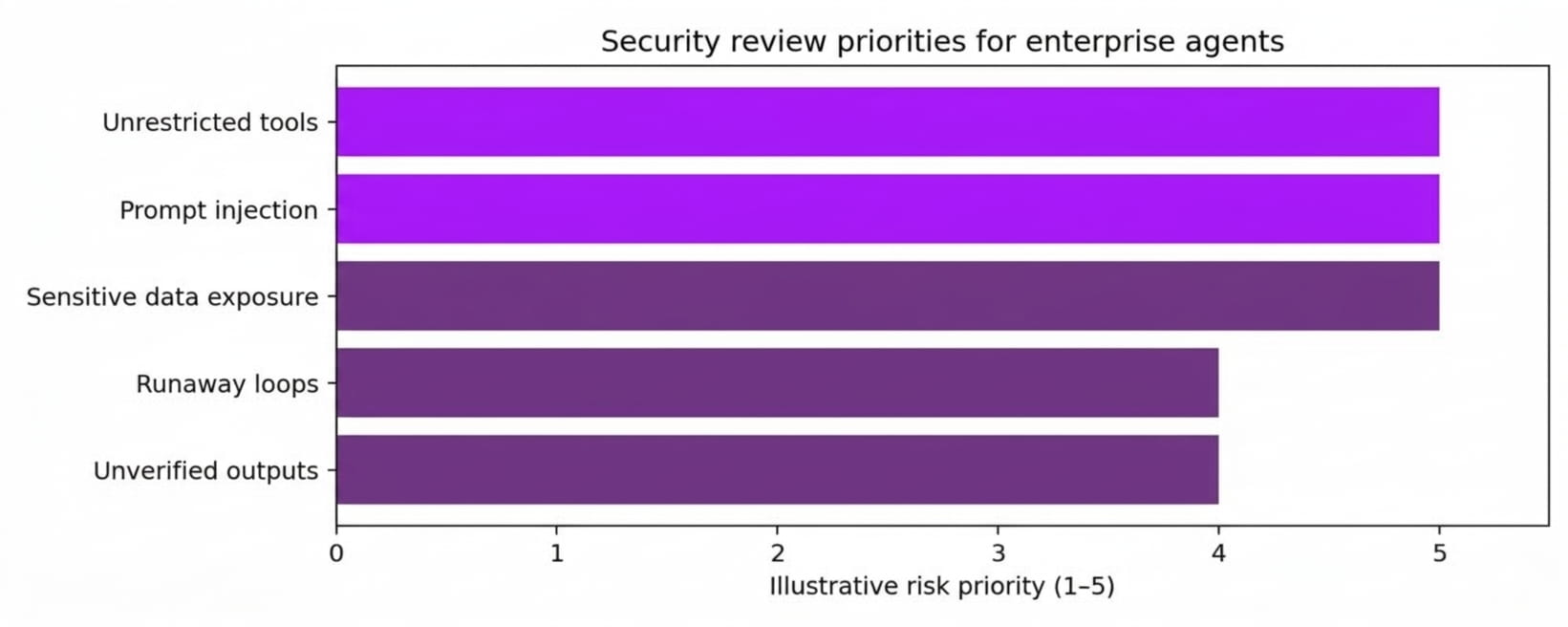
Figure 2. Illustrative risk-priority scores for security review; not empirical incident rates.The OWASP guidance for LLM applications and the NIST AI Risk Management Framework provide useful starting points. For enterprise deployments, map AI-specific controls to existing security and privacy programs rather than creating a disconnected approval process.
6. Evaluate behavior before production
Testing an agent requires more than checking whether its final response sounds correct. Build a representative evaluation set containing routine requests, ambiguous inputs, missing records, malicious instructions, permission conflicts, API failures, and cases that require escalation. Measure task completion, factual accuracy, tool selection, policy compliance, human override rate, latency, and cost.
Use offline evaluations before deployment and sampled online reviews afterward. Record versioned prompts, model versions, tools, policies, and datasets so failures can be reproduced. Run red-team tests for prompt injection, exfiltration, unauthorized actions, and looping behavior. Define hard stop conditions and maximum spend per task.
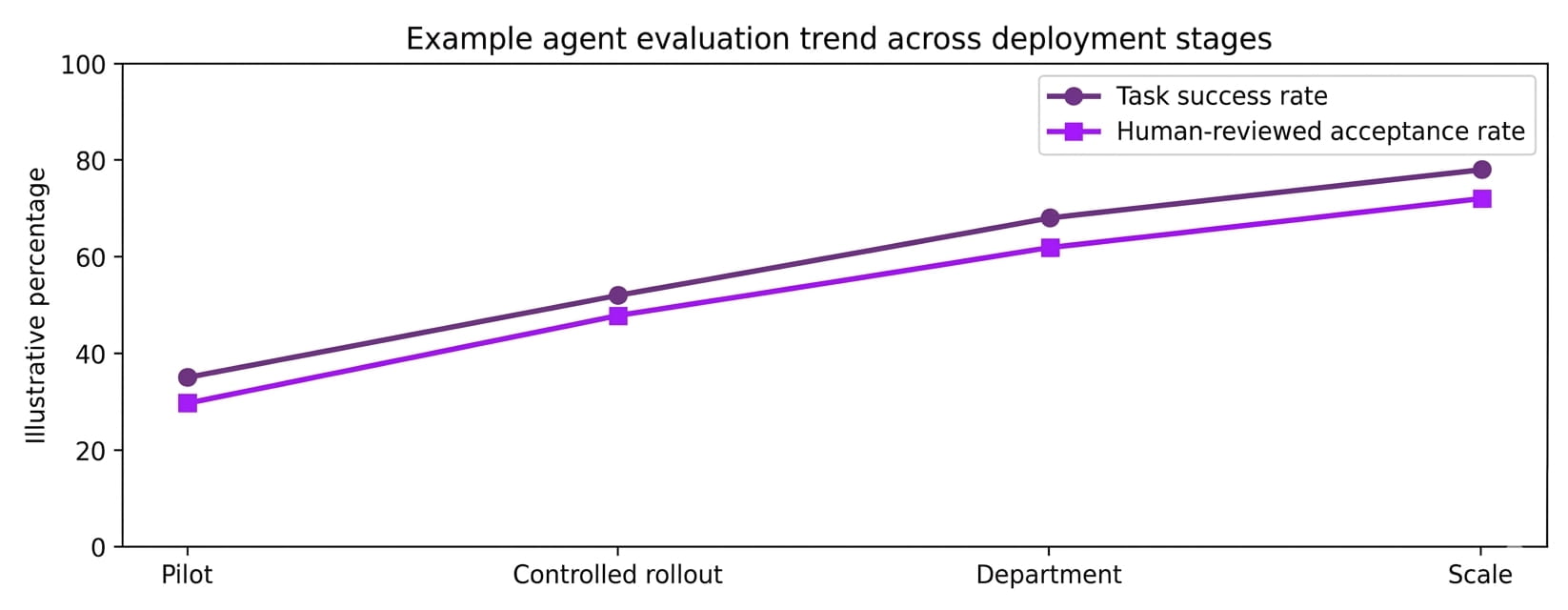
Figure 3. Hypothetical evaluation trend showing why staged validation matters; not benchmark data.
7. Plan cost, performance, and reliability
Agent costs include model tokens, retrieval, vector storage, API calls, orchestration, logging, infrastructure, engineering, security review, and human oversight. Multi-step agents can consume substantially more resources than one-turn assistants because they may call models and tools repeatedly. Optimize by reducing unnecessary context, caching safe results, selecting appropriately sized models, and using deterministic code for predictable tasks.
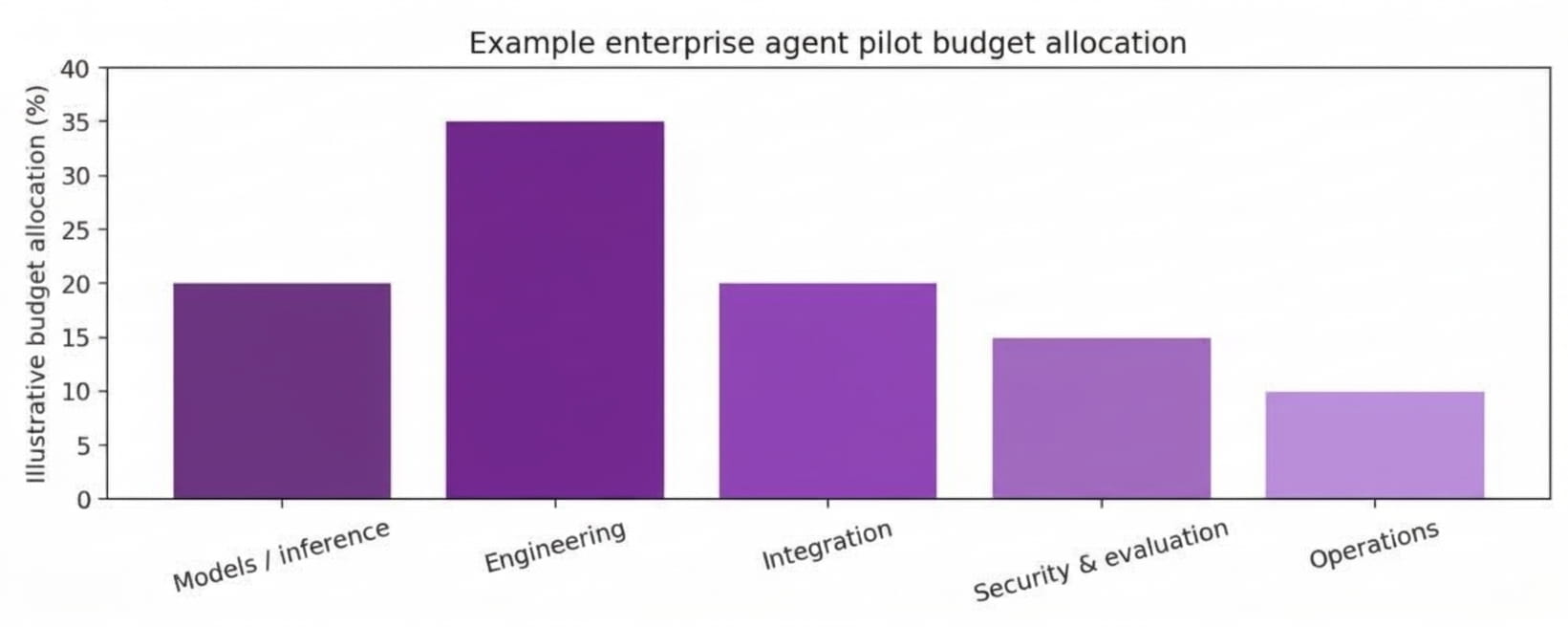
Figure 4. Example pilot budget allocation; illustrative only and not a market pricing estimate.Build resilience into tool calls using timeouts, bounded retries, circuit breakers, deduplication, and compensation steps where appropriate. A failed CRM update must not silently be treated as success. Agents should clearly report incomplete tasks and route unresolved cases to humans.
8. Follow a phased deployment roadmap
| Phase | Deliverable | Exit criterion |
| Discover | Workflow map and baseline | Owner and measurable KPI |
| Prototype | Read-only agent | Useful outputs on sample tasks |
| Secure pilot | Scoped tools and approval gates | Security tests and evaluation thresholds |
| Controlled rollout | Production monitoring and runbooks | Stable outcomes and recovery |
| Scale | Reusable agent platform patterns | Demonstrated ROI and governance |
Begin with read-only operations and human-reviewed drafts. Add write actions only after access controls, evaluation results, and recovery processes are proven. Expand one workflow at a time; broad multi-agent architectures should be justified by actual coordination requirements, not assumed to be more advanced.
9. Measure business value and ROI
Measure outcomes against the pre-deployment baseline. Useful metrics include time to resolution, cost per completed task, manual touches per case, error rate, escalation rate, customer satisfaction, and avoided rework. Financial benefits should reflect realized savings or valuable capacity redeployment rather than automatically converting every saved minute into cash.
For example, if a workflow handles 6,000 cases monthly and validated automation saves two minutes per case, it releases 200 hours of potential capacity per month. At an illustrative fully loaded cost of $35 per hour, that equals $7,000 in theoretical capacity value. It is not necessarily $7,000 in cash savings. Subtract platform, support, integration, review, and infrastructure expenses before claiming positive ROI.
10. Best practices checklist
- Define a narrow outcome and baseline before choosing a framework.
- Enforce identity and authorization outside the model.
- Expose scoped, typed, auditable tools instead of broad credentials.
- Use human approval for sensitive or irreversible actions.
- Test prompt injection, failures, and ambiguous requests.
- Cap execution steps, retries, time, and cost.
- Version prompts, tools, models, and evaluation datasets.
- Provide monitoring, incident response, and human escalation.
- Review data retention, privacy, and third-party contracts.
- Scale only after reliability and business value are demonstrated.
Frequently asked questions
What is the difference between an AI agent and a chatbot?
A chatbot primarily answers questions; an agent may also coordinate permitted tools and actions to complete a task. The distinction depends on actual system capabilities, not marketing terminology.
Do enterprise agents require multiple AI models?
No. A single model with scoped tools and deterministic orchestration can be sufficient. Multiple models or agents should be added only when there is a clear need.
Is RAG required for enterprise AI agents?
Not always. Retrieval-augmented generation is valuable when agents need current enterprise knowledge, but many transactional workflows depend more on structured APIs.
How do you secure agent tool calls?
Authenticate each call, enforce least privilege in the destination system, validate arguments, log actions, and require approvals for sensitive operations.
How long does implementation take?
A narrow prototype may take weeks, while production deployment can take months depending on integrations, security requirements, data readiness, and governance.
How should agent ROI be measured?
Compare verified task outcomes and fully loaded operating costs with the existing workflow, including exceptions and human review.
Conclusion: Build for trust before autonomy
Enterprise AI agents can help organizations coordinate knowledge work and business processes, but reliable results require much more than a capable model. Successful teams begin with specific workflows, modular architecture, narrow tool permissions, realistic evaluations, and measurable business outcomes. A staged rollout gives organizations a practical way to improve autonomy without losing accountability.
Thepermatech can use this guide to help business leaders frame an AI discovery conversation: identify the highest-value workflow, assess integration and security requirements, and scope a measurable pilot before enterprise rollout.