
Executive summary
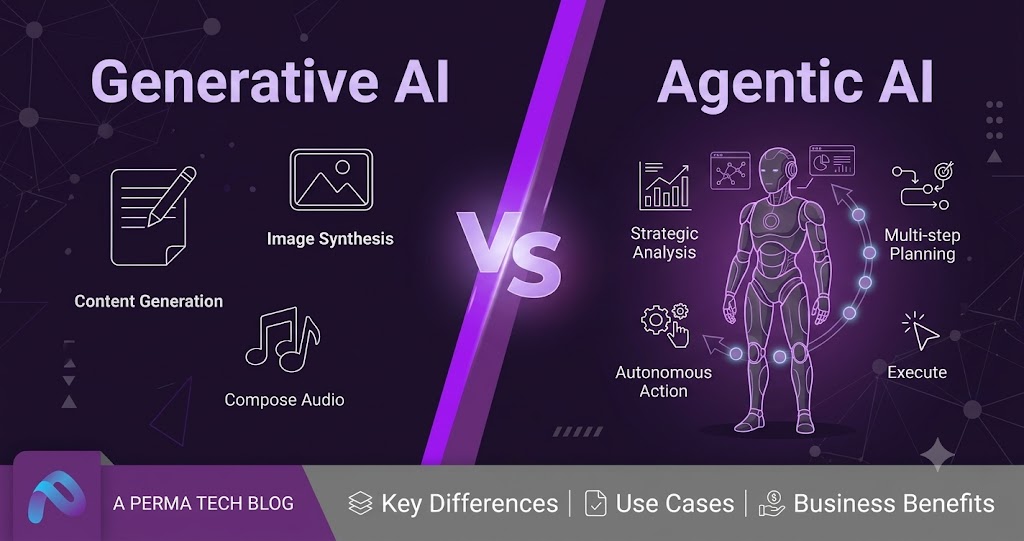
Artificial intelligence is changing how organizations create content, analyze information, automate workflows and serve customers. Two approaches are especially relevant for business leaders: generative AI and agentic AI. Although the terms are sometimes used interchangeably, they describe different patterns of capability and control. Generative AI is typically used to create or transform information. Agentic AI uses models, tools and workflow logic to pursue goals through multiple steps. Understanding this distinction helps organizations invest in systems that solve real business problems rather than adding unnecessary complexity.
What Is Generative AI?
Generative AI refers to models and applications that produce new text, code, images, audio, video or other content based on prompts and contextual information. A business user may ask an assistant to summarize a report, draft an email, explain a financial metric or suggest software tests. The system generates a response, which a person or another application can review and use. Large language models power many text-based applications, while other generative model architectures support image and media creation.
Generative AI can also incorporate enterprise information through retrieval-augmented generation (RAG). A knowledge assistant, for example, may retrieve relevant policy documents before producing an answer. This improves access to business context but does not eliminate errors. Organizations still need to validate accuracy, enforce document permissions and protect sensitive information. The central advantage of generative AI is its ability to accelerate information-intensive work.
Common generative AI use cases
Marketing teams can draft campaign concepts, sales teams can prepare account summaries, developers can generate code suggestions and documentation, and customer support teams can create response drafts. HR departments may use it to organize onboarding content, while finance teams may summarize reports. These applications are especially valuable when employees remain responsible for reviewing and approving the final output.
What Is Agentic AI?
Agentic AI describes systems designed to work toward a defined goal by selecting steps, using available tools, interpreting results and adjusting subsequent actions. Rather than only drafting a response, an agentic application can interact with approved APIs, retrieve records, perform checks, update workflow state and escalate exceptions. Agentic does not necessarily mean unsupervised: enterprise systems frequently require human approval before consequential actions.
Consider supplier invoice processing. A generative model may extract details and explain discrepancies. An agentic system may retrieve the invoice, compare it with purchase-order data, check business rules, request approval and update the accounting system when authorized. That additional coordination creates opportunities for automation, but also raises requirements for access control, monitoring, rollback and audit trails.
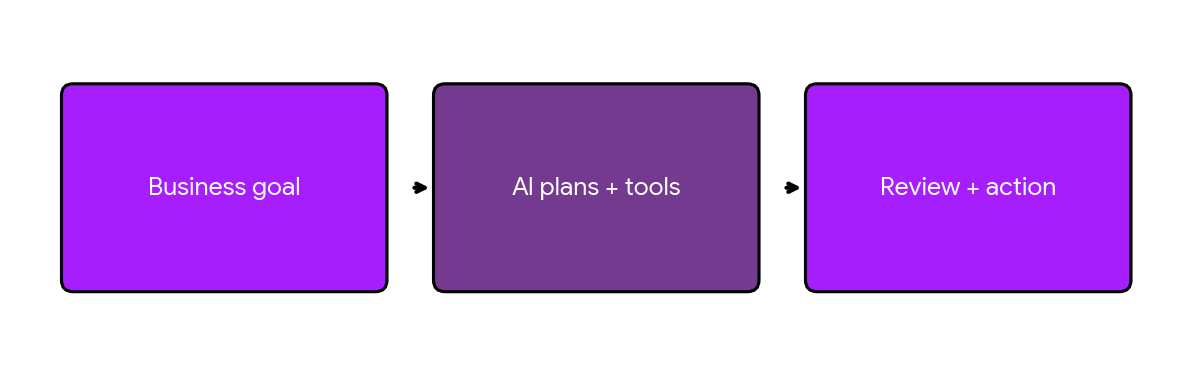
Simplified agentic workflow with a goal, tool-based execution and approval.
Generative AI vs. Agentic AI: Key Differences
Although the two technologies overlap, they differ in their primary objectives, operational behavior, and implementation requirements.
| Feature | Generative AI | Agentic AI |
| Primary purpose | Generate or transform content | Pursue goals and coordinate tasks |
| Typical input | Prompt or instruction | Goal, constraints, and context |
| Typical output | Text, code, images, insights | Completed workflow or action |
| Planning | May generate plans | Can use plans to guide execution |
| Tool integration | Optional | Commonly central |
| Autonomy | Usually user-directed | Variable, from supervised to more autonomous |
| Feedback | Often user-driven | Can use tool and environment feedback |
| Human involvement | Review generated output | Approve, supervise, or intervene |
| Implementation complexity | Often lower | Often higher |
| Security considerations | Content, privacy, model outputs | All generative risks plus action permissions |
| Example | Draft a customer email | Resolve a support request through connected systems |
The categories overlap. Many agentic systems use generative models to interpret instructions, draft messages or decide which tool to call. The important architectural distinction is whether the application merely generates information or can take controlled steps in external systems. Neither approach is universally better: the right choice depends on the workflow and the acceptable level of operational risk.
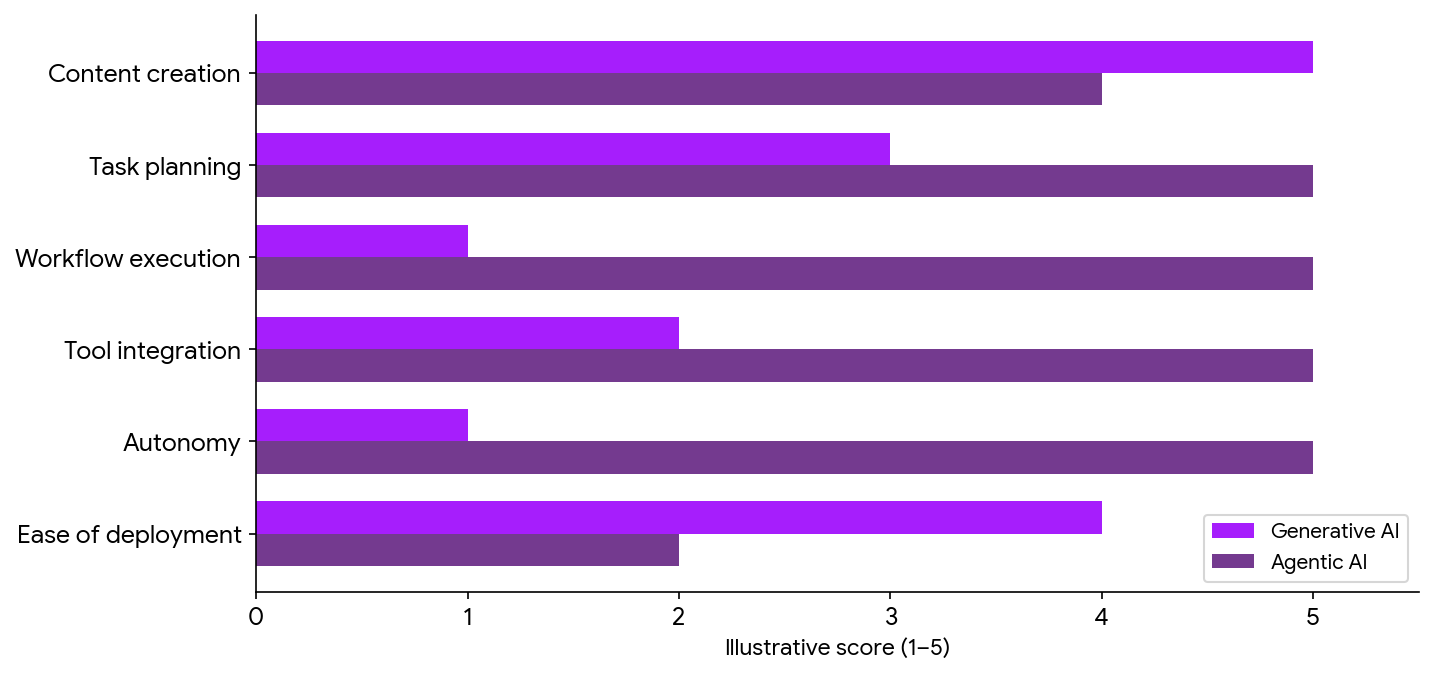
Qualitative capability comparison; scores are illustrative, not measured benchmarks.
Business Benefits of Generative AI and Agentic AI
Both technologies offer significant opportunities, but their value depends on the problem being addressed.
- Employee productivity
Generative AI helps employees complete drafting, summarization, research and analysis tasks more efficiently. Agentic AI can reduce coordination work by connecting multiple steps across systems. For example, an onboarding assistant might draft welcome materials, while a supervised agent could also prepare account requests, coordinate scheduling and track completion. Benefits should be measured against existing workflows rather than assumed from tool adoption alone.
- Operational efficiency and cost management
Repetitive activities such as document classification, ticket routing and invoice checks are candidates for AI assistance. A generative application can reduce manual interpretation, while an agentic application can orchestrate several stages of a process. However, additional tool calls, integrations, evaluations and monitoring increase costs. A business case should consider exception rates, human review time and maintenance alongside possible labor savings.
- Customer experience
Generative AI can help customer service representatives produce clearer, faster responses. Agentic AI can potentially check an order, locate shipping status, create a ticket or propose an approved replacement. This can improve first-contact resolution, but only when identity verification, transaction limits and escalation paths are designed carefully. The objective should be accurate resolution rather than merely maximizing automation.
- Better decisions and scalability
Generative systems can make complex information easier to understand. Agentic systems can collect evidence and coordinate approved follow-up actions. Both can help businesses scale knowledge-intensive operations, but neither guarantees sound decisions. High-impact outcomes still require appropriate validation, human accountability and clear procedures for handling uncertainty.
| Industry | Generative AI | Agentic AI |
| Financial services | Report summaries and policy explanations | Document checks and approved exception routing |
| Healthcare | Administrative documentation assistance | Scheduling and authorized administrative workflows |
| Manufacturing | Maintenance knowledge retrieval | Coordinate alerts, work orders and inventory checks |
| Retail | Product content and support drafts | Order status and approved returns workflows |
| IT services | Code assistance and incident summaries | Ticket triage and controlled remediation workflows |
Industry context determines the acceptable degree of autonomy. In regulated or safety-critical environments, permission boundaries, validation, auditability and human review are particularly important. A useful initial deployment often begins with read-only access and expands only after reliability has been demonstrated.
How Generative and Agentic AI Work Together
An enterprise sales workflow illustrates the combination. A sales representative defines an outreach objective. Generative AI drafts tailored communications and summarizes relevant account information. An orchestration layer retrieves authorized CRM records, organizes tasks and checks whether the proposed actions meet business rules. A person approves the outreach before messages are sent or records are updated. This design captures the content capabilities of generative AI and the workflow capabilities of agentic AI without surrendering control.
The same pattern can be applied to IT operations. A model may summarize an incident and suggest a remediation plan. An agentic layer may gather logs and run approved diagnostic commands, while production changes remain subject to explicit authorization. This separation of analysis, execution and approval is an important enterprise design principle.
Challenges, Risks and Governance
| Risk | Potential impact | Recommended control |
| Hallucinations | Incorrect answers or decisions | Grounding, evaluations and review |
| Prompt injection | Manipulated instructions | Treat retrieved content as untrusted |
| Excessive permissions | Unauthorized actions | Least-privilege tool access |
| Workflow loops | Repeated calls and unexpected cost | Limits, timeouts and alerts |
| Sensitive-data exposure | Privacy or confidentiality incidents | Classification and access controls |
| Integration failures | Duplicate or incomplete actions | Idempotency and recovery paths |
The NIST AI Risk Management Framework provides a useful structure for identifying, assessing and managing AI risks. Enterprises should extend familiar security practices with model evaluation, prompt-injection testing, action-level authorization, logging and incident response. Agentic AI warrants particular scrutiny because errors can propagate into business systems rather than remaining confined to generated text.
ROI Example: Support Workflow Automation
Consider a hypothetical company processing 10,000 support requests each month. If validated AI assistance reduces average handling effort from eight minutes to five, the organization frees approximately 500 handling hours per month. At an assumed loaded labor rate of $30 per hour, that represents $15,000 in theoretical monthly capacity value. Capacity is not automatically a cash saving: financial benefits depend on whether the company reduces overtime, avoids incremental hiring or redeploys effort productively.
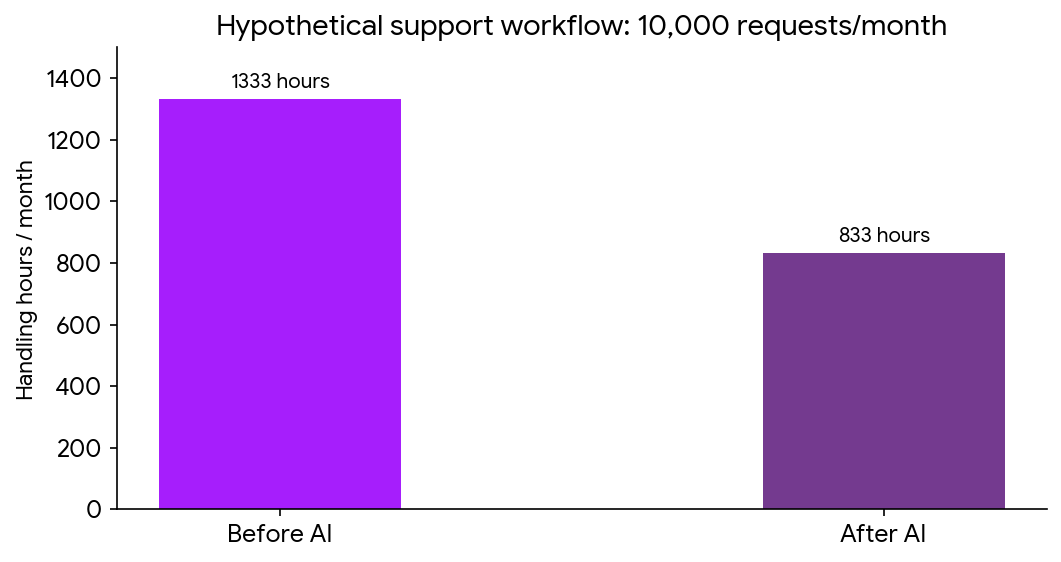
Hypothetical support-handling comparison; not an industry benchmark.
A complete ROI model must subtract model usage, infrastructure, integration, training, monitoring, security and support costs. It should also track accuracy, customer satisfaction, exception rates and employee adoption. Establish a baseline before deployment and compare results using representative data.
How to Choose the Right Approach
Choose generative AI when the primary objective is producing content, interpreting documents, answering questions or assisting employees with knowledge work. Consider agentic AI when a clearly defined process requires multiple steps across applications and the actions can be constrained, verified and audited. For high-risk workflows, start with supervised, read-only or approval-based agents. Traditional rule-based automation may remain preferable for predictable, deterministic tasks.
A Practical 12-Week Pilot Roadmap
| Phase | Timing | Deliverable |
| Assess opportunity | Weeks 1–2 | Use case, baseline, data and risk assessment |
| Prototype | Weeks 3–5 | Focused generative AI application |
| Connect tools | Weeks 6–8 | Approved integrations and tests |
| Pilot agentic actions | Weeks 9–11 | Supervised workflow and audit logs |
| Evaluate | Week 12 onward | ROI review and scale/no-scale decision |
This is an illustrative sequence, not a guaranteed project timeline. Integration with legacy systems, regulated information and complex approval processes may require substantially longer. Start with one measurable workflow, evaluate failures and only expand autonomy when evidence supports the change.
The Future of Enterprise AI
Looking toward 2027, businesses are likely to combine generative capabilities with increasingly sophisticated orchestration and workflow automation. The practical opportunity is not to replace every existing process with autonomous agents. It is to identify where models can reduce information work and where controlled tool use can eliminate unnecessary coordination. Organizations that invest in data quality, identity management, integration standards, evaluation and observability will be better positioned to adopt both approaches responsibly.
Frequently Asked Questions
What is the main difference?
Generative AI creates or transforms information; agentic AI coordinates steps and tools to pursue a goal.
Is agentic AI better?
Not inherently. It is useful for multi-step processes, but adds complexity and risk.
Can the two work together?
Yes. Agentic applications often use generative models for language understanding and content creation.
Does agentic AI require human supervision?
Supervision should be proportional to the consequences of an action. High-impact activities should have approval controls.
Can small businesses use agentic AI?
Yes, for narrow, well-defined workflows using existing software and appropriate permissions.
How should success be measured?
Compare cost, quality, handling time, adoption, exception rates and realized benefits against a baseline.
Conclusion
Generative AI and agentic AI are complementary rather than competing technologies. Generative AI accelerates content and knowledge work, while agentic AI can coordinate authorized actions across business systems. The right strategy begins with a concrete business problem, establishes strong governance and measures results before scaling. For enterprises planning AI adoption in 2027, disciplined implementation will matter more than selecting the most autonomous technology available.