
Artificial Intelligence (AI) has rapidly evolved from an experimental technology into a core business capability. Organizations across industries from healthcare and finance to retail and manufacturing are embedding AI into decision-making, automation, customer engagement, and operational efficiency.
However, deploying AI at scale is not simple. It requires robust infrastructure, reliable data pipelines, security governance, continuous optimization, and specialized talent. This is where Managed Services Providers (MSPs) play a transformational role.
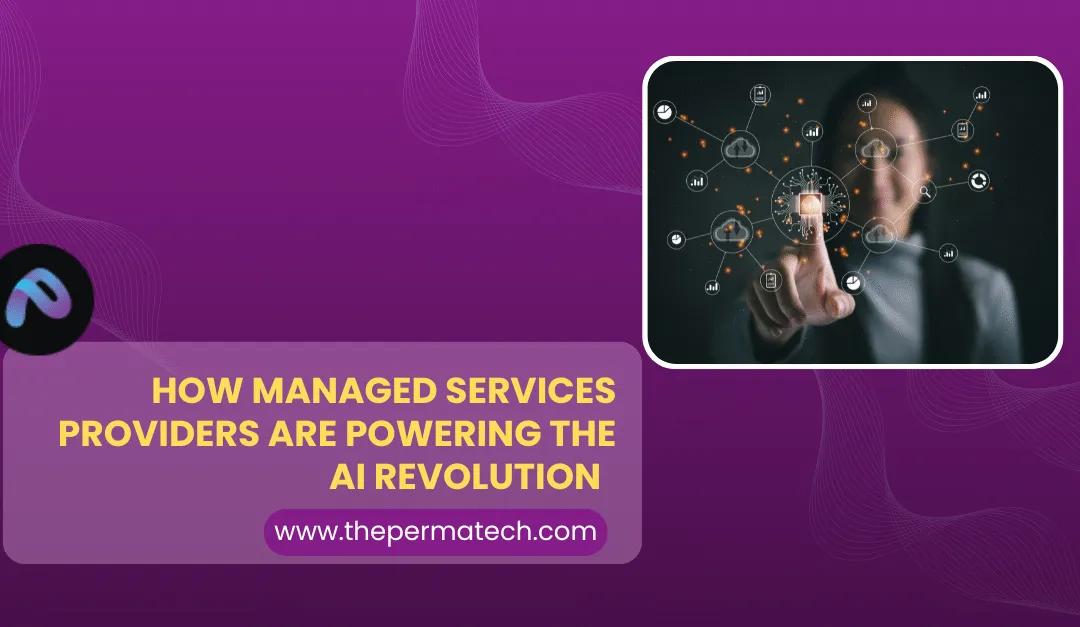
Managed Services Providers are no longer just IT support vendors. They are becoming strategic AI enablers, helping enterprises design, deploy, secure, and continuously optimize AI-driven ecosystems. In today’s AI revolution, MSPs act as the backbone that makes innovation practical, scalable, and sustainable.
The Growing Complexity of AI Adoption
Before understanding the role of MSPs, it’s important to recognize why AI adoption is challenging for enterprises.
Key Challenges Organizations Face with AI
| AI Challenge | Description |
| Infrastructure scalability | AI workloads require elastic compute, GPU resources, and high availability |
| Data readiness | AI models depend on clean, labeled, and governed data |
| Security & compliance | AI systems introduce new attack surfaces and regulatory risks |
| Skills shortage | AI engineers, MLOps experts, and data scientists are scarce |
| Model lifecycle management | Models must be monitored, retrained, and optimized continuously |
| Cost optimization | Cloud-based AI can quickly become expensive without governance |
These challenges explain why many AI initiatives fail to move beyond pilot stages. Managed Services Providers help organizations bridge this gap.
What Is the Role of Managed Services Providers in AI?
Managed Services Providers deliver end-to-end operational support for AI environments—spanning cloud, data, security, automation, and analytics.
Instead of enterprises building everything in-house, MSPs provide AI-ready platforms, tools, and expertise that accelerate time-to-value.
Core Areas Where MSPs Power the AI Revolution
- AI-ready cloud infrastructure
- Data engineering and governance
- MLOps and model lifecycle management
- AI security and compliance
- Automation and intelligent operations (AIOps)
- Continuous optimization and cost control
1. Building AI Ready Cloud Infrastructure
AI workloads demand high-performance, scalable infrastructure. MSPs design and manage cloud-native AI environments using AWS, Azure, and Google Cloud.
How MSPs Enable AI Infrastructure
- GPU and TPU provisioning for ML workloads
- Auto-scaling for training and inference
- Hybrid and multi-cloud AI architectures
- High availability and disaster recovery
- Infrastructure-as-Code (IaC) for repeatability
Example:
An MSP can configure an Azure AI stack using Azure Machine Learning, Kubernetes, and managed databases—allowing data scientists to focus on models rather than infrastructure.
2. Data Management: Fueling AI with the Right Data
AI systems are only as good as the data they consume. Managed Services Providers help organizations establish robust data pipelines that feed AI models reliably.
MSP-Driven Data Capabilities
| Data Capability | Business Impact |
| Data ingestion & ETL | Faster access to structured and unstructured data |
| Data lakes & warehouses | Centralized AI-ready data storage |
| Data quality monitoring | Improved model accuracy |
| Data governance & lineage | Regulatory compliance and transparency |
| Real-time data streaming | AI-driven decision-making |
With managed data services, enterprises eliminate data silos and create a single source of truth for AI.
3. MLOps: Operationalizing AI at Scale
One of the biggest barriers to AI success is the lack of operational discipline. MSPs bring MLOps (Machine Learning Operations) practices that turn models into reliable production systems.
What MSPs Deliver with MLOps
- CI/CD pipelines for ML models
- Model versioning and rollback
- Automated testing and validation
- Performance monitoring and drift detection
- Scheduled retraining pipelines
AI Lifecycle with MSP Support
| Stage | MSP Responsibility |
| Model development | Environment setup and tooling |
| Deployment | Secure and scalable rollout |
| Monitoring | Accuracy, bias, and drift tracking |
| Optimization | Performance tuning |
| Retirement | Controlled model decommissioning |
This structured approach ensures AI systems remain accurate, fair, and valuable over time.
4. AI Security, Ethics, and Compliance
AI introduces new risks data leaks, biased algorithms, model poisoning, and regulatory violations. MSPs integrate security by design into AI platforms.
Key AI Security Services from MSPs
- Secure data access controls
- AI model encryption and isolation
- Identity and access management (IAM)
- Compliance with GDPR, HIPAA, SOC 2, ISO 27001
- Explainable AI (XAI) frameworks
Current Update:
With new AI regulations emerging globally (EU AI Act, U.S. AI governance frameworks), MSPs help organizations stay compliant without slowing innovation.
5. AIOps: Using AI to Manage IT Itself
Interestingly, MSPs don’t just support AI,they use AI internally to manage IT environments more efficiently. This is known as AIOps (Artificial Intelligence for IT Operations).
AIOps Capabilities Delivered by MSPs
| AIOps Use Case | Benefit |
| Predictive incident detection | Reduced downtime |
| Automated root cause analysis | Faster resolution |
| Intelligent alerting | Less noise for IT teams |
| Capacity forecasting | Optimized resource usage |
| Self-healing systems | Improved reliability |
This creates a virtuous cycle where AI improves IT operations, which in turn supports more advanced AI workloads.
6. Cost Optimization and AI Financial Governance
AI can be expensive if not managed properly. MSPs apply FinOps principles to AI environments.
How MSPs Control AI Costs
- Usage monitoring and optimization
- GPU workload scheduling
- Right-sizing cloud resources
- Budget alerts and forecasting
- AI workload prioritization
Analytical Insight:
According to industry benchmarks, organizations using managed cloud and AI services reduce AI infrastructure costs by 20–35% compared to unmanaged environments.
Industry Use Cases: AI + Managed Services in Action
Healthcare
- AI-powered diagnostics
- Patient data analytics
- Secure, compliant AI platforms
Retail & E-commerce
- Recommendation engines
- Demand forecasting
- AI-driven personalization
Finance
- Fraud detection
- Risk modeling
- Regulatory reporting automation
Manufacturing
- Predictive maintenance
- Quality inspection via computer vision
- Supply chain optimization
In each case, MSPs provide the operational backbone that allows AI to deliver measurable business outcomes.
Why Managed Services Are Critical to the Future of AI
The AI revolution is accelerating but success depends on execution, not experimentation alone.
Key Advantages of MSP-Led AI Adoption
- Faster time-to-market
- Reduced operational risk
- Access to specialized expertise
- Continuous innovation
- Predictable costs
As AI systems become more complex, enterprises will increasingly rely on trusted managed services partners rather than building everything internally.
The Road Ahead: Managed Services as AI Co-Innovators
Looking forward, MSPs will evolve from service providers into AI co-innovators, helping organizations:
- Deploy generative AI responsibly
- Integrate AI copilots into business workflows
- Build industry-specific AI models
- Enable autonomous operations
AI is no longer optional and managed services are no longer secondary. Together, they define the future of digital transformation.
Conclusion
Managed Services Providers are the unsung heroes of the AI revolution. By combining cloud expertise, data engineering, security, MLOps, and automation, MSPs empower organizations to move from AI ambition to AI impact.For enterprises seeking scalable, secure, and sustainable AI adoption, partnering with the right Managed Services Provider is not just a technical decision,it’s a strategic imperative.