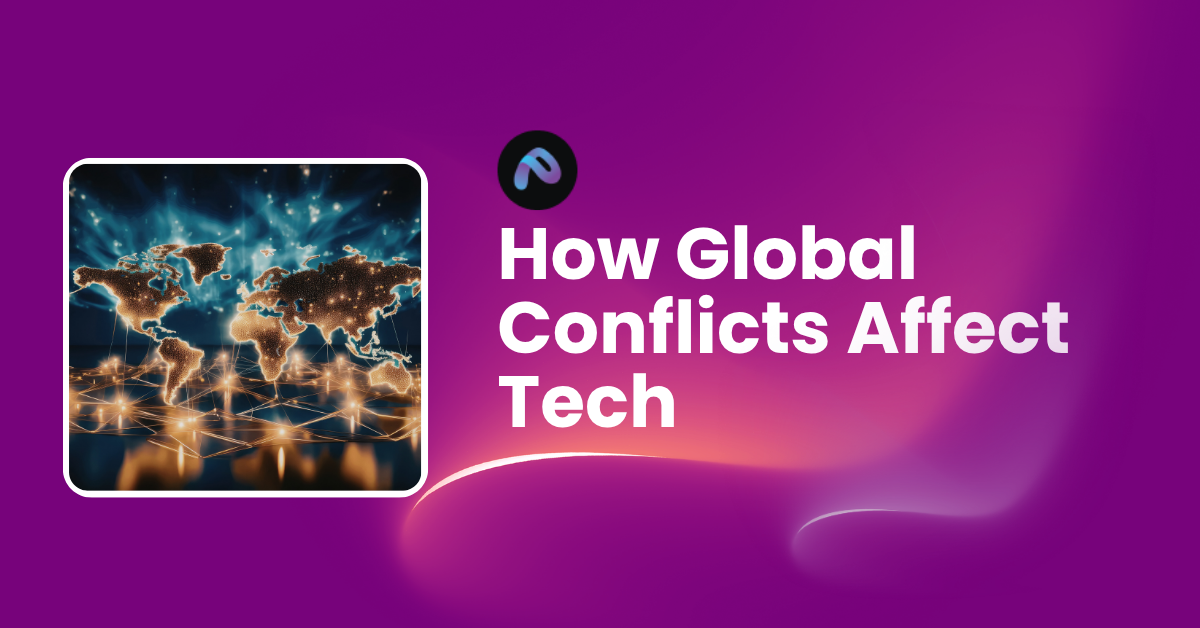

In today’s hyperconnected world, technology does not exist in isolation. Every line of code, every cloud deployment and every digital product is indirectly shaped by global events. Among the most influential of these are geopolitical conflicts wars, sanctions, trade disputes and regional instability.
From disrupted semiconductor supply chains to cybersecurity escalation, global conflicts are redefining how the tech industry operates. Businesses that rely on digital infrastructure must now think beyond innovation and consider resilience, adaptability and geopolitical awareness.
This article explores how global conflicts impact the tech ecosystem from infrastructure to software development and why organizations investing in custom digital solutions are better positioned to navigate uncertainty.
👉 Learn more about resilient digital systems
1. The New Reality: Tech Is Geopolitical
Over the last decade, technology has shifted from being purely commercial to deeply strategic. Governments now view tech infrastructure as national assets, and conflicts increasingly play out in cyberspace as much as on physical battlefields.
Recent global events such as the Russia-Ukraine war, U.S.-China trade tensions, and Middle East conflicts have shown that:
- Cloud services can become restricted overnight
- Supply chains can collapse within weeks
- Software dependencies can turn into vulnerabilities
Technology is no longer just about performance,it’s about control, sovereignty and resilience.
2. Supply Chain Disruptions: The Semiconductor Crisis
One of the most visible impacts of global conflicts is on hardware supply chains especially semiconductors.
Key Insight:
Over 75% of global semiconductor manufacturing is concentrated in East Asia, making it highly vulnerable to geopolitical tensions.
Impact Breakdown
| Factor | Impact on Tech Industry | Example |
| War zones | Factory shutdowns | Ukraine neon gas supply disruption (critical for chip manufacturing) |
| Trade sanctions | Restricted exports | U.S. restrictions on advanced chips to China |
| Shipping disruptions | Delayed hardware delivery | Red Sea shipping instability affecting logistics |
| Resource shortages | Increased costs | Rare earth material scarcity |
Analytical Perspective
- Semiconductor prices increased by 20–40% globally during peak shortages (2021–2023)
- Lead times for chips extended from 12 weeks to over 52 weeks
- Companies shifted toward multi-region sourcing strategies
This directly affects software companies too because infrastructure costs rise, deployment slows, and scaling becomes expensive.
3. Cybersecurity: The Rise of Digital Warfare
Modern conflicts are increasingly fought through cyberattacks.
Key Trends:
- State-sponsored hacking groups targeting infrastructure
- Ransomware attacks increasing during geopolitical tensions
- Critical industries (finance, healthcare, energy) becoming primary targets
Cyberattack Growth Data
| Year | Estimated Global Cybercrime Cost | Growth Rate |
| 2020 | $3 trillion | — |
| 2023 | $8 trillion | +166% |
| 2025 (Projected) | $10.5 trillion | +31% |
What This Means for Businesses
- Increased need for secure architecture
- Demand for custom-built systems instead of generic SaaS
- Continuous monitoring and threat detection becoming mandatory
Global conflicts accelerate cyber threats, forcing organizations to rethink how their applications are designed.
4. Talent Displacement and Remote Work Shifts
Wars and conflicts also affect human capital,the backbone of the tech industry.
Example: Ukraine Tech Workforce
- Before 2022: Ukraine had over 300,000 software developers
- During the conflict: Thousands relocated or worked under unstable conditions
- Many global companies had to restructure teams overnight
Workforce Impact Table
| Factor | Effect on Tech Teams |
| Migration | Talent relocation across Europe and Asia |
| Connectivity issues | Reduced productivity |
| Economic instability | Rising outsourcing costs |
| Brain drain | Loss of specialized expertise |
Analytical Insight
This has led to:
- Increased adoption of distributed development models
- Greater reliance on custom collaboration tools
- Companies investing in redundant team structures across regions
5. Cloud Infrastructure Fragmentation
Global conflicts have fragmented the once global nature of cloud computing.
Key Changes:
- Data localization laws increasing
- Regions blocking or restricting foreign cloud providers
- Rise of “sovereign cloud” infrastructure
Cloud Fragmentation Comparison
| Region | Cloud Policy Trend |
| Europe | Strong data sovereignty (GDPR enforcement) |
| China | Strict control, domestic cloud dominance |
| USA | Export restrictions on AI/compute tech |
| Middle East | Growing localized cloud investments |
Impact on Development
- Applications must be region-aware
- Data architecture needs compliance-based segmentation
- Increased complexity in deployment pipelines
This is where custom web applications become critical—because off-the-shelf solutions often cannot adapt to regional compliance requirements.
6. Economic Instability and Tech Investment
Global conflicts directly influence economic conditions, which in turn affect tech funding and growth.
Investment Trends
| Year | Global Tech Investment | Trend |
| 2021 | $680B | Peak growth |
| 2023 | $420B | Decline due to instability |
| 2025 | $500B (Projected) | Recovery with caution |
Key Observations
- Investors are prioritizing resilient, scalable solutions
- SaaS growth is stabilizing, while custom enterprise solutions are rising
- Companies are reducing dependency on external platforms
7. Shift Toward Custom Built Solutions
One of the most important outcomes of global instability is a shift in how businesses approach software.
Why Custom Solutions Are Rising
| Challenge | Limitation of SaaS | Advantage of Custom Development |
| Security risks | Shared infrastructure | Dedicated architecture |
| Compliance | Limited flexibility | Fully adaptable |
| Scalability | Vendor constraints | Tailored scaling |
| Integration | Rigid APIs | Fully integrated systems |
Businesses are moving away from generic tools and investing in tailored applications that can adapt to geopolitical changes.
👉 Explore how custom solutions help:
8. AI and Defense: A Growing Intersection
Artificial Intelligence is becoming central to modern conflicts—and this impacts the broader tech ecosystem.
Key Developments
- Governments investing heavily in AI for defense
- Increased regulation of AI exports
- Dual-use technology (civil + military)
AI Market Growth
| Segment | Growth Rate |
| AI in defense | 13–15% CAGR |
| Enterprise AI | 20–25% CAGR |
| Generative AI | 30%+ CAGR |
This leads to:
- Stricter regulations
- Ethical considerations
- Increased demand for controlled, custom AI deployments
9. Strategic Takeaways for Businesses
Global conflicts are not temporary disruptions,they are long-term structural shifts.
What Companies Should Do
- Build resilient systems
Avoid single-region dependencies
- Invest in custom applications
Tailored solutions provide flexibility
- Prioritize cybersecurity
Design security-first architectures
- Adopt distributed teams
Reduce risk of talent disruption
- Ensure compliance readiness
Prepare for regional data laws
Conclusion
From war zones to codebases, the ripple effects of global conflicts are reshaping the technology landscape. What once seemed like distant geopolitical issues are now directly influencing how software is built, deployed, and secured.
In this evolving environment, agility is no longer optional,it is essential.
Organizations that rely on rigid systems will struggle. Those that invest in flexible, scalable, and secure custom solutions will not only survive but thrive.
Technology is no longer just about innovation,it’s about resilience in an unpredictable world.