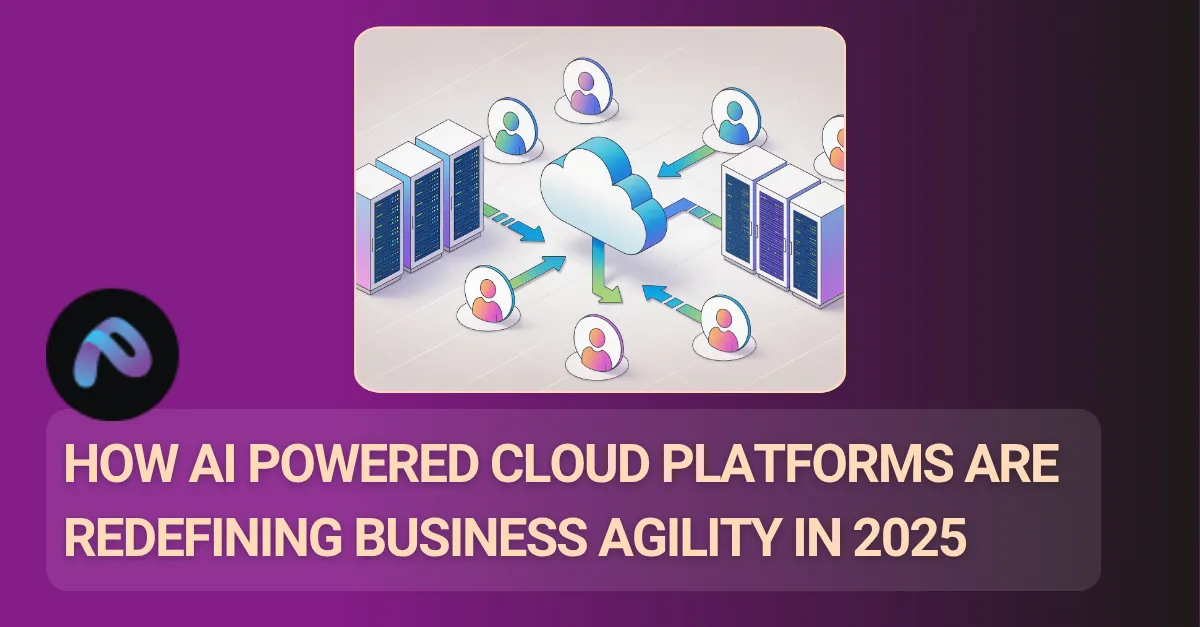

Cloud computing has evolved beyond storage and scalability. In 2025, the cloud is not just infrastructure,it’s intelligence in motion.
Leading providers like AWS, Azure, and Google Cloud are embedding AI native capabilities directly into their architectures, enabling businesses to react to market shifts faster than ever.
According to Gartner’s 2025 forecast, organizations using AI enhanced cloud services will see a 35% improvement in operational efficiency and 28% faster time to market compared to traditional setups.
Key Drivers of AI Powered Cloud Adoption
| Driver | Impact on Agility | Examples (2025) |
| Predictive Automation | AI automates scaling, load balancing, and resource optimization | AWS AutoPilot CloudWatch AI |
| Edge + AI Integration | Enables faster insights closer to the data source | Microsoft Azure Edge AI, Google Distributed Cloud |
| Adaptive Security Models | AI-driven anomaly detection enhances cybersecurity | IBM Watson Security, CrowdStrike Falcon X |
| Data-Driven DevOps | AI helps predict deployment failures and code anomalies | GitHub Copilot + Azure DevOps Insights |
The Cloud Intelligence Flywheel
The Cloud Intelligence Flywheel is a self reinforcing cycle where AI continually learns from real time operations to make cloud environments smarter, faster and more adaptive. It transforms the cloud from a passive infrastructure layer into an active, decision making ecosystem.
Data Collection:
Modern cloud environments generate billions of signals every second. Sensors, application logs, metrics and user behavior data are continuously captured to provide a real time view of system health and performance.
AI Interpretation:
Machine learning models analyze this data at scale, detecting patterns, uncovering bottlenecks and identifying optimization opportunities long before they impact end users. This turns raw telemetry into instant intelligence.
Autonomous Action:
Instead of waiting for human intervention, AI driven cloud components automatically scale up resources, self heal services, rebalance workloads, enforce security rules, or reroute traffic to maintain seamless performance.
Continuous Learning:
Every automated adjustment feeds back into the system. The models refine their predictions, strengthen their anomaly detection and get better at anticipating future issues creating a continuously improving agility engine.
Together, these stages create a flywheel effect that accelerates over time, enabling organizations to deploy new services, adjust to demand changes and evolve their digital operations in minutes rather than months. This is the foundation of the next generation of cloud powered innovation.
Cloud AI Real World Impact: Industries Leading in 2025
| Sector | AI Cloud Use Case | Measured Outcome (2025) |
| Healthcare | AI diagnostics & patient analytics on hybrid cloud | 43% faster data processing |
| Retail | AI forecasting for supply chain & inventory | 35% less overstock waste |
| Finance | Fraud detection using AI-trained cloud clusters | 57% reduction in false positives |
| Manufacturing | Predictive maintenance using IoT + AI Cloud | 29% fewer equipment downtimes |
A 2025 Accenture survey revealed that 94% of top performing firms now integrate AI within their cloud environments, attributing up to 40% ROI growth to this synergy.
Security, Compliance and Ethical Governance
As AI driven cloud systems evolve, so does the responsibility to govern them ethically.
- Explainable AI frameworks (XAI) ensure transparency.
- Federated learning secures private data during model training.
- Cloud compliance automation through AI driven audits reduces risk by up to 50%, according to McKinsey’s 2025 report.
Cloud Native AI & Hyperautomation : The Road Ahead
By late 2025, Generative AI will merge deeply with serverless and edge architectures:
- Generative CloudOps: Automated documentation, code deployment and system remediation.
- AI Enhanced FinOps: Real time cost optimization across hybrid environments.
- Quantum + AI Cloud: Early stage pilots in logistics and drug discovery are already underway with Google’s Quantum AI division.
Conclusion
AI powered cloud platforms have transformed agility from a goal into a measurable business advantage. In 2025, the cloud operates not just as infrastructure but as an intelligent engine that predicts needs, optimizes performance and responds in real time. Companies embracing AI driven automation, adaptive security and cloud native intelligence can innovate faster, scale effortlessly and react instantly to market shifts. As Generative CloudOps, AI enhanced FinOps and emerging quantum integrations accelerate this evolution, the cloud becomes a true strategic partner. The organizations that thrive will be those that let the cloud think, adapt and innovate on their behalf.