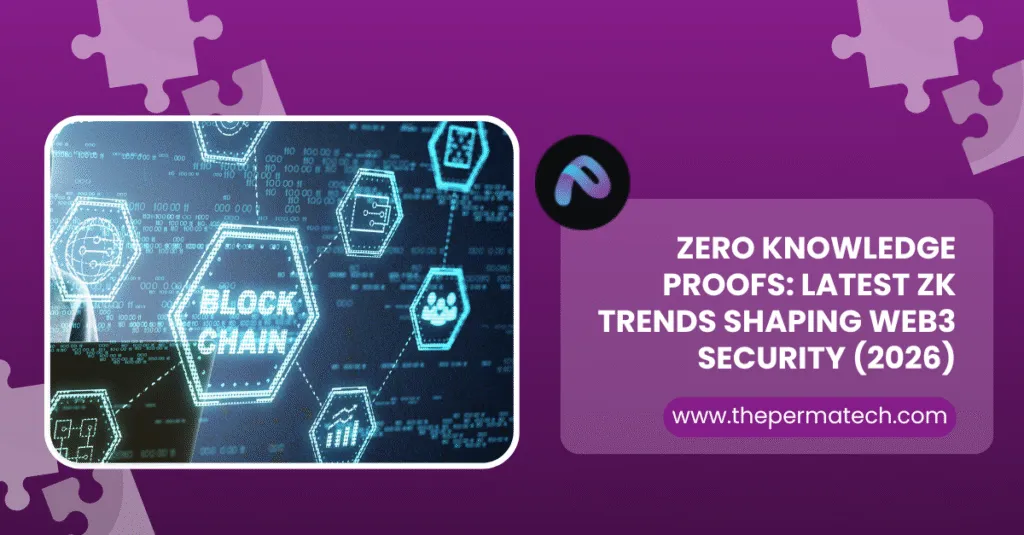

As Web3 matures in 2026, security, privacy and regulatory compliance have become non-negotiable requirements for decentralized systems. With increasing adoption of blockchain across finance, identity, healthcare, gaming, and supply chains, protecting sensitive data while maintaining transparency is one of the biggest challenges.
This is where Zero-Knowledge Proofs (ZKPs) emerge as a foundational technology.
Zero-Knowledge Proofs enable one party to prove the validity of information without revealing the underlying data itself. In an era of rising cyber threats, AI-powered attacks, and stricter global data protection laws, ZKPs are reshaping how trust is established in Web3.
In this article, we explore the latest Zero-Knowledge Proof trends in 2026, real world applications, emerging ZK architectures, performance breakthroughs, and how enterprises are leveraging ZK technology to build secure, scalable, and privacy-first blockchain solutions.
What Are Zero Knowledge Proofs? (Quick Refresher)
A Zero-Knowledge Proof allows a prover to convince a verifier that a statement is true without revealing any additional information beyond the validity of the statement.
Core Properties of ZKPs
| Property | Description |
| Completeness | Valid statements always pass verification |
| Soundness | Invalid statements cannot be proven |
| Zero-Knowledge | No private data is disclosed |
In Web3, this enables privacy-preserving transactions, secure identity verification, and scalable blockchain computations.
Why ZK Technology Is Critical for Web3 Security in 2026
The 2026 Web3 Landscape
- Regulatory scrutiny (GDPR, HIPAA, MiCA, DPDP)
- Enterprise blockchain adoption
- AI-driven fraud and exploits
- High transaction volumes and Layer-2 scaling needs
Zero-Knowledge Proofs address all of these challenges simultaneously by enabling:
- Private yet verifiable transactions
- Trustless authentication
- Off-chain computation with on-chain validation
- Reduced attack surfaces
Latest Zero-Knowledge Proof Trends in 2026
1. ZK-Rollups Dominate Blockchain Scalability
ZK-Rollups have become the preferred Layer-2 scaling solution over optimistic rollups due to faster finality and stronger security guarantees.
Why ZK-Rollups Lead in 2026
- Instant transaction finality
- No fraud-proof delay
- Lower gas costs
- Ethereum-grade security
Leading ZK-Rollup Networks (2026)
| Network | Focus Area |
| zkSync Era | General-purpose smart contracts |
| Starknet | High-performance ZK computation |
| Scroll | EVM-equivalent ZK rollups |
| Polygon zkEVM | Enterprise & DeFi scaling |
SEO Keywords: ZK Rollups 2026, Ethereum scalability, Layer 2 blockchain security
2. zkSNARKs vs zkSTARKs: Performance Evolution
Both zkSNARKs and zkSTARKs are evolving rapidly, with hybrid implementations emerging in 2026.
| Feature | zkSNARKs | zkSTARKs |
| Trusted Setup | Required | Not required |
| Proof Size | Smaller | Larger |
| Quantum Resistance | Low | High |
| Computation Speed | Faster verification | Faster generation |
2026 Trend:
Many platforms now use zkSTARKs for enterprise and long-term security, while zkSNARKs remain dominant in consumer DeFi due to efficiency.
3. Zero-Knowledge Identity (ZK-ID) Becomes Mainstream
Decentralized Identity (DID) systems increasingly rely on ZKPs to enable privacy preserving identity verification.
Use Cases
- KYC without data exposure
- Age and citizenship proofs
- Cross-border identity validation
- DAO governance voting
Example
A user can prove:
“I am over 18 and KYC-verified”
without revealing name, address, or documents.
SEO Keywords: Zero-knowledge identity, decentralized identity Web3, privacy-preserving KYC
4. ZK-Powered Privacy in DeFi and Payments
DeFi in 2026 has shifted from fully transparent ledgers to selective privacy models using Zero-Knowledge Proofs.
ZK DeFi Use Cases
- Private token transfers
- Confidential trading volumes
- Shielded lending positions
- Hidden liquidation thresholds
Benefits
- Reduced MEV attacks
- Improved institutional adoption
- Regulatory friendly compliance proofs
5. ZK-ML: Securing AI Models on Blockchain
A major 2026 breakthrough is Zero Knowledge Machine Learning (ZK-ML).
ZK-ML allows:
- Verifying AI inference without exposing model weights
- Auditing AI decisions without revealing data
- Secure on-chain AI predictions
Industries Adopting ZK-ML
| Industry | Use Case |
| Finance | Fraud detection validation |
| Healthcare | Secure diagnostics |
| Supply Chain | Predictive analytics |
| Defense | Classified AI decision proofs |
6. Hardware-Accelerated ZK Proof Generation
One of the historical limitations of ZKPs was high computational cost. In 2026, this barrier is rapidly falling.
Innovations
- GPU-optimized ZK compilers
- ASIC-based ZK accelerators
- Cloud-native ZK proof services
| Metric | 2022 | 2026 |
| Proof Generation Time | Minutes | Seconds |
| Cost per Proof | High | Reduced by ~70% |
| Enterprise Adoption | Limited | Widespread |
7. Enterprise Adoption of Zero Knowledge Proofs
Large enterprises now deploy ZKPs for compliance, data sharing and secure collaboration.
Enterprise Use Cases
- Confidential audits
- Secure multi-party computation
- Data marketplaces
- Supply chain verification
Key Advantage:
Enterprises can prove compliance without exposing proprietary data.
Analytical View: Impact of ZK Technology in 2026
ZK Adoption Growth (Estimated)
| Year | ZK-Based Apps |
| 2022 | ~150 |
| 2024 | ~650 |
| 2026 | 2,000+ |
Key Drivers
- Privacy regulations
- Ethereum scaling needs
- AI-blockchain convergence
- Institutional DeFi growth
Challenges Still Facing Zero Knowledge Proofs
Despite rapid progress, challenges remain:
- Developer complexity
- Limited debugging tools
- High memory requirements
- Standardization gaps
However, ZK-friendly programming languages, compilers, and SDKs in 2026 are dramatically lowering the entry barrier.
How Perma Technologies Leverages Zero Knowledge Proofs
At Perma Technologies, Zero Knowledge Proofs are a core component of our Blockchain & Web3 Security Services.
Our ZK Capabilities
- ZK Rollup architecture design
- Privacy first smart contracts
- ZK enabled identity solutions
- Secure enterprise blockchain systems
- Compliance ready Web3 platforms
We build scalable, secure and future ready blockchain solutions aligned with global regulatory and enterprise requirements.
The Future of Zero Knowledge Proofs Beyond 2026
Looking ahead:
- ZK powered Internet identity
- Fully private DAOs
- AI + ZK governance models
- Quantum resistant blockchain security
Zero Knowledge Proofs are no longer experimental, they are core infrastructure for Web3 security.
Conclusion
In 2026, Zero Knowledge Proofs stand at the intersection of privacy, security, scalability and trust. From Ethereum scaling to decentralized identity, AI verification and enterprise compliance, ZK technology is shaping the future of Web3. Organizations that adopt Zero Knowledge Proofs today are positioning themselves for a secure, compliant and decentralized tomorrow.